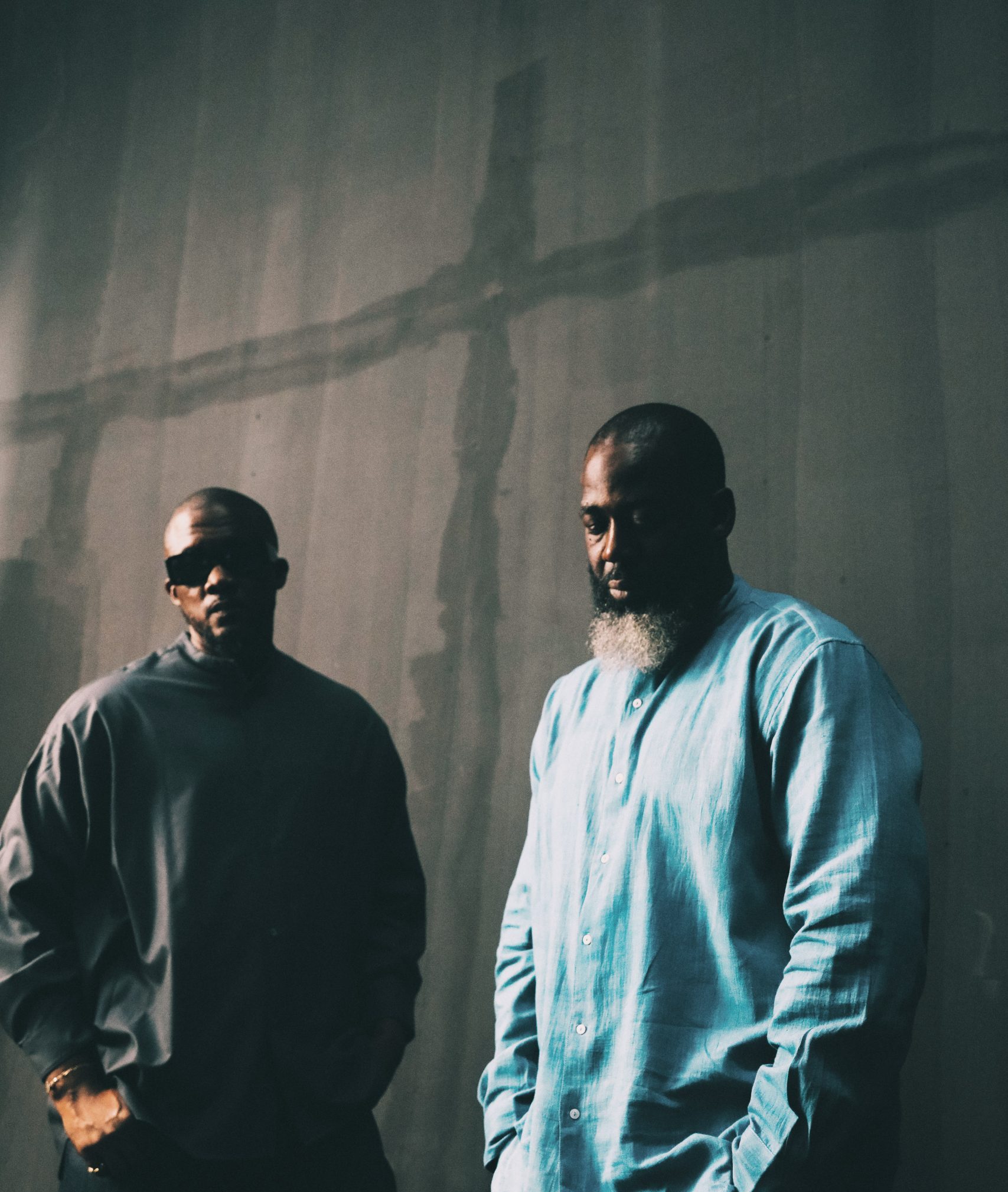
The path to a classic album is rarely a straight shot. For Show Dem Camp’s Tec and Ghost, the journey to their latest, ‘Afrika Magik,’ was a winding road full of detours. The album was first dreamed up right after they dropped the game-changing ‘Palmwine Music Vol. 1’, but then life, and their fans, had other plans. The runaway success of that sound pulled them into a series of sequels and the raw energy of the ‘Clone Wars’ series. After a while, those defined lanes started to feel a little tight. “We were either recording for Palmwine or Clone Wars, and some songs didn’t fit either world,” Tec reveals. “After a while, it became restrictive. So we asked: do we create more worlds, or do we merge everything?”
The answer is the vibrant, collaborative tapestry of ‘Afrika Magik.’ An album born from a little over three years of stop-start creation, intense travel, and a series of studio camps from Lagos to Ghana. It’s a project that unlocks the duo from their sonic lanes, allowing them to operate with a new, cinematic freedom. “We pictured ‘Afrika Magik’ as our own TV station where we are showing our own movies,” Tec explains. “If each song is a movie, who is the right actor to act in it?”
For Tec, this collaborative spirit is what keeps the engine running. He sees humanity in every part of the process, from the PR team and writers to the artists who jump on a track. “It’s all human beings at the end of the day that are creating and are lending their time and energy to what you do,” he explains. You get the sense he’d be just as happy in the crowd at a 50-person show for a collaborator as he would be headlining his own festival. This is a genuine belief in a creative community. It’s this very web of connections that he says keeps them “curious and excited”, constantly presenting a new puzzle to solve.
This deep respect for collaboration shaped the album’s soul, pulling in a vibrant, pan-African cast like Moonchild Sanelly, Lusanda, and Joey B. Artists who became part of Show Dem Camp’s extended family. And then there’s the album’s heart; its social commentary. Woven through with the nostalgic sound of old Nollywood narrations, ‘Afrika Magik’ challenges what we think of as “magic”. For SDC, real magic is the stunning reality of African creation; building film and music industries from the ground up and dominating global sports with the limited facilities we have. “We take it for granted,” Tec asserts, “but we are excelling despite the challenges. That form of creation is a form of magic.”
In this exclusive interview with iMullar, we speak to Tec(Wale Davies) of Show Dem Camp as he delves deep into the making of ‘Afrika Magik,’ navigating the weight of their own legacy, and their vision for building community in the Afrika Magik era.
This interview has been edited for clarity and length.
How is the post-album release period treating you?
It’s been good. This year we’re doing an intense media run, which we haven’t done for a while. It has been good; there has been a lot of media, press, and opportunities to talk about the album and share what it is about. To be honest, we have really enjoyed it.
You’ve both bounced between Lagos, London, and beyond before planting roots back home. How has that “perpetual outsider” lens shaped the wanderlust in tracks like “Italawa”? Is there a specific city memory that haunts a verse?
That’s a great question. I think one of the main things it did was, across my travels, allow me to meet a lot of interesting people. A lot of our previous work featured artists mostly from our community in Lagos or the broader music community in Nigeria, but on this album, through my travels, we connected with different artists who share a very similar approach, ethos, and principles. By expanding our reach, we expanded the type of artists we worked with. On this project, you have Moonchild Sanelly from South Africa, Lusanda from South Africa, Mereba from the US (who is also Ethiopian), and Joey B from Ghana. These are people who have recently become friends, part of an extended community we’ve built in those places from our travels. That’s one way it definitely shaped the album.
Secondly, just being free with music. From touring and seeing what people respond to in other countries, we realized that some of these playful songs, ones we didn’t even know had that kind of connection within our catalog, were resonating. So we thought about how we could expand on that, taking insights from the sounds we heard and what people were dancing to in different places. Lastly, I would say it’s about the quality and access: access to better studios, access to better mixing and mastering engineers. It’s a more global world now; the person who mastered our album is somewhere in middle America. We’re able to connect with different people all over, and that is the joy of being privileged enough to travel to these places.

“Normally,” which features Joey B and Boj, starts with a stripped-down Gyedu-Blay Ambolley flow. What was the approach to this record, especially as it was the introduction to the world of “Afrika Magik”? What made it the perfect introduction?
There were two songs, actually (the other might make the deluxe version), that were both produced by Guilty Beats. The initial idea came because I’ve been in Ghana a lot more recently, staying there often. I connected with Guilty Beats, and he said he’d always wanted to flip this song by Ambolley called “Simi Rap.” I was immediately on board. The first thing I ever knew of Ambolley was from an album by Mensa and Wanlov the Kubolor called ‘Cos ov Moni’, where a line said, “Ambolley created hip hop.” That made me research him, and I saw that this guy was rapping prior to when rap was officially recognized. To me, it sounded like rap, but perhaps because the music didn’t get the global reach, it wasn’t acknowledged. So when Guilty wanted to sample it, I was definitely down. It felt like a perfect segue into ‘Afrika Magik’, a way to pay homage to someone who created magic and this sound.
We reached out to Ambolley through his grandson, an artist in Ghana called Drupz, who connected us. Ambolley was gracious enough to give us permission. Then, I invited Joey B to the studio. I’ve been a fan of his music and his flow for a long time. We found out we’re both huge Busta Rhymes fans. I told him that every time I heard “Tonga,” I felt he rapped on African beats so seamlessly. We actually set two records together; one of them is on Boj’s album, called “Shana.”
The Palmwine Music and Clone Wars series established distinct moods and sonic palettes. How does this new album fit into or expand that universe? Is it a continuation, a divergence, or a synthesis?
It’s fun to look back. Before “Palmwine” and “Clone Wars”, we released a project called ‘Dreamer Project‘, our first album. It was pre-streaming, on CD, so I don’t know how far it reached, but it was very effective. However, it didn’t really catch on in Nigeria until we had a hit from it, “Farabale” with May D. The next success after that was “Feel Alright” with BOJ & Poe. After “Feel Alright,” we moved to the UK and didn’t connect as much for a while. We did other songs until we met our producer, Spax, who wanted to go back to that highlife, Palmwine sound. We created ‘Palmwine Music Vol. 1’ with him, almost four years after “Feel Alright” was released. Our next plan at that time was actually to release ‘Afrika Magik’ right after ‘Palmwine Music Vol. 1’. That’s why on ‘Palmwine Music Vol. 2’, there’s a song called “Tales by Moonlight” featuring Tems where we reference ‘Afrika Magik’; that song was being recorded for this project then. But because we had released ‘Vol. 1’, everyone started asking for ‘Vol. 2’. We felt people weren’t ready to receive anything else, so we decided to explore the Palmwine sound some more. We did ‘Palmwine Music Vol. 2’, ‘Palmwine Express’ (which wasn’t originally meant for the series), and then ‘Palmwine Vol. 3’. At the same time, we were doing Clone Wars. It got to a point where it felt restrictive; we were either recording for ‘Palmwine’ or ‘Clone Wars’, and some songs didn’t fit either world. So we asked, do we create more worlds, or do we merge everything? This album hopefully opens up new channels for us. We create where we are at emotionally, mentally, and spiritually, and we can’t force something if it’s not where we’re at. This album is fun and unlocks us from making only one or two styles of music.
Can you walk us through the narrative of this album from the first track to the last? Was there a specific “hinge” track that everything else was built around?
We created this album over three years, but it was stop-and-start. Two years ago, we went to Ghana for an SDC camp and invited artists like Manifest and Guilty Beats. From those sessions, the only song that made it onto this project is the intro, “Libations.” Then last year, while releasing ‘No Love In Lagos’, we did more sessions, and a song like “I’ll Wait,” the last track, came from that. This year, the main meat of the album was created. I’m fortunate to host a Sony camp in Ghana annually, and artists like Lusanda were there. Off the back of that, we did our own smaller camp, and that’s where most of the album was finalized. Initially, the idea for the intro was a more Hip-Hop, spiritual African album, but over time, it morphed into what you hear now. We wanted to showcase the best of our network, which is very much African, and it came very organically. We tried to lock into concepts, but that wasn’t how we were feeling. We just created and tapped in with people we were inspired by.
How did you approach curating the beats for this project? Were you giving producers a thematic brief, or did the beats themselves dictate the direction?
We tried to create a theme initially, but it didn’t really work. A lot of it was just conversations: this is how I’m feeling, this is what I want to say, this is an artist I’m interested in. How do we bring this artist into our world and get the best out of them? The guitarist, Nsikak, and the producer also played a part, suggesting how an artist’s voice might sound. With Moonchild, for instance, I’d never done a song like that before, so we figured out how to get her into our pocket. It ended up becoming very free-flowing. We create on the spot with musicians, like our guitarist, and the artists. It was very organic, and that process shaped the rest of the album. We’d get a track and then think, “We have this now; we need this other color to paint with,” and then create in that lane.

Your flows are conversational and effortlessly woven together. On this album, were there any tracks where you deliberately challenged each other’s rhythmic patterns or pushed the technicality of your verses?
We challenge each other all the time. I’m more interested in flow and cadence, and Ghost is more interested in lyrics, what we’re saying. That’s why I like an artist like Joey B; his cadence is very smooth. Over time, I’ve moved from being more lyrical to wanting the words that sound sweetest in the song, using rap almost as an accompaniment or instrument. Ghost is about saying the craziest things lyrically. We balance each other well; you get flow and you get lyrics. If you’re a lyric head, you gravitate towards Ghost. I try to make my words very direct and conversational, as if we’re having a conversation. My favorite rapper used to be Nas for his intricate stories, but now I lean more towards Jay-Z for his simplicity and clarity. “I’m not a businessman. I’m a businessman”, it doesn’t seem that lyrical, but it is actually lyrical because it’s simple in its simplicity. It’s a gift to be able to say something simple that is still impactful. I’m always trying to challenge Ghost to make it smoother and more digestible, and he’s always trying to challenge me to give more bars. It’s a good balance that keeps us both sharp.
Some of the records start with a narrator speaking on themes and memories of old Nollywood. The album also featured skits with the same format. How essential was it to incorporate this element?
It was very essential. It helps drive home the message subtly; we never want to signpost what we’re talking about. We use social commentary, which art is meant to be a reflection of the times. A skit like “White Juju,” for example, has multiple layers. If you try to have a conversation about African spirituality, many people get scared, but if I said a voice in a dark room would talk to you and help solve your problems, you’d probably run. Yet, we can log on to ChatGPT, ask about our mental health, and a human voice will answer, and we’re not scared of that; we think it’s amazing. It poses a question: if something is branded African, do we rate it? If a Babalawo gives you the same answer as ChatGPT, who do you believe? It’s social commentary couched in humor. Ayo Ade, who did the skits, mentioned in a conversation we had that she doesn’t know ‘The Godfather’ but knows ‘Jenifa’s Diary’. Our lives were marked by these Nollywood characters, yet we lean more to Western lore. We think ‘The Godfather’ is more iconic than ‘Jenifa’s Diary’, but why? How do we champion our own stuff? Our own stuff was influential and impactful in our lives growing up, too.
For me, the idea that people created a film industry where there was none, a music industry where there was none, fashion brands out of nothing, and that sports stars excel from a continent with barely any facilities, that’s a form of magic. We take it for granted, but globally, we are excelling in spite of the challenges. That form of creation is a form of magic, our innate magic, and we are celebrating that.
The album features artists like Tems, Joey B, Winny, Taves, and longtime collaborator BOJ. What inspired these collaborators? What specific “void” or new perspective does each fill, and how do you ensure a guest verse feels integral to the SDC story?
We pictured ‘Afrika Magik’ as our own TV station where we are showing our own movies. If each song is a movie, who is the right actor to act in it? For “Normally,” with its energy and vibe, Joey B and Boj were the perfect people. On a song like “Spellbound” featuring Lusanda or “Magik” featuring Moonchild Sanelly, they have more of the song than we do because that’s what the song called for. On “Magik” with Moonchild, the flow and structure of that song is very unorthodox; it’s not verse-chorus-verse. We did what felt right. If this is the actor and this is the opening monologue, we’re not cutting it short; we play our role within the context of the film. Entering the film world, what I really appreciate is their collaboration. How many hands come together to create a film? Everybody has their role and respects each other’s roles. When everything is done well, the film flows seamlessly. That was our approach to collaborating this time: who is the best person to tell this part of the story? We’re not just using them. Joey B, for example, didn’t even really rap on that song; he had a four-bar part that repeats. But that’s what the song called for. If that means we appear less on a track, then that’s what it is.
Following a critically acclaimed project like “Palmwine Music Vol. 3” and The Cavemen collaborative album, “No Love In Lagos,” brings expectations. How did you navigate the weight of your own legacy while trying to create something fresh and authentic?
I think for us, we’re students of music; we’re curious. Everything we do is more or less an experiment. How do we find a new artist we love? How do we continue to create? I actually think legacies will be defined by other people. We know what we want our legacy to be, but that may not be how people receive it. We’re just creating, and the fact that we can do this after so many years as our job, creating music with our friends, is a beautiful thing. We don’t stop ourselves; right after an album, everyone is asking when we’re going back to the studio. The studio is the place I enjoy being the most.
As long as we have the curiosity to explore new sounds and work with new people, we will continue. We are honest with ourselves; if something isn’t popping, we don’t release it. We just make it for fun. Ultimately, it’s about making good music.

The Palmwine Festival started as a 600-person dream and ballooned to thousands. What’s the wildest moment from those camps that turned a loose cypher into a hit, and how are you evolving it for the Afrika Magik era?
The festival was a response to feeling there weren’t many platforms where people could create and play music that excited them. Performing in Lagos was often at VIP events where you get 10 minutes and can’t experiment. We decided to create our own thing, and even if it was small, we would build it. It was one of the best decisions we’ve ever made. The wildest thing for me is that people keep showing up. It’s a mixture of really young kids, older people, and parents, our music resonates across generations. In some years, we don’t even have a new album out, but people still come for the same show. I think it’s the community we build and the type of space we create. This year, with ‘Afrika Magik’ released, it’s going to be a really beautiful show.
What’s next for Show Dem Camp in 2025/2026? Will we see another Palmwine Festival in Accra, or will you venture into Southern or Eastern Africa?
Last year, we brought back Palmwine Sessions, which is meant to be a more intimate version of the festival. We started missing those intimate shows where you can really feel the energy from the audience. This year, we did one in Lagos and a hybrid one in London. We have the Palmwine Festival in Lagos and the Palmwine Sessions in Abuja. I think somewhere in the first quarter of next year, we will aim to do a Palmwine Session in Accra. This might give away some information, but it would make more sense when we do the Deluxe, because there may be some more Ghanaian artists on there.
Follow @theimullar on Instagram and X(Twitter) for more.